

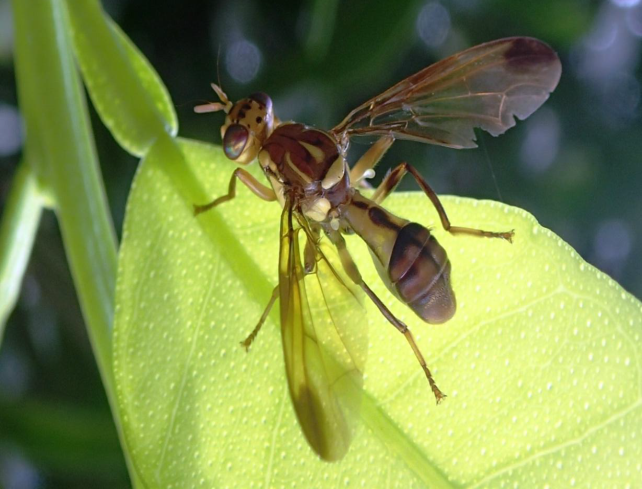
Bactrocera minax
Crop: Citrus
Why is it a problem? The Chinese fruit fly is the most serious insect pest in citrus. Up to 70% of losses through late fruit drops have been reported.
Where and when is it a problem? In eastern Bhutan, in higher orchards (over 1000 m altitude) and shady orchards at lower altitude, fruit drop is over 80% attributable to Citrus fly. In lower orchards, citrus fruit fly could be detected in all orchards visited, but the main cause of fruit drop is probably the citrus shield bug. At very low altitudes (below 600 m asl), some fruit-sucking moths may be involved in fruit drop as well.
IDENTIFICATION
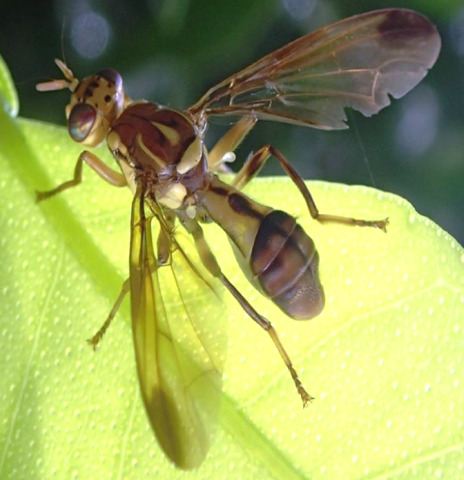
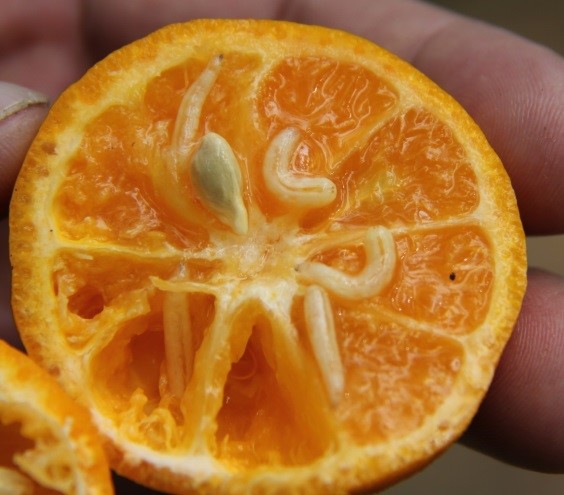
Adults have a general wasp-like appearance, are almost 1.5 cm long (wingspan up to 1 cm), and are brownish with yellow markings. Wings have a dark band along the outer margin. Females possess a long and exposed ovipositor. Larvae (maggots) are creamy-white with black mouthparts. They measure 12–15 mm when mature. The puparium is yellowish-brown and 8–11 mm long.

SYMPTOMS
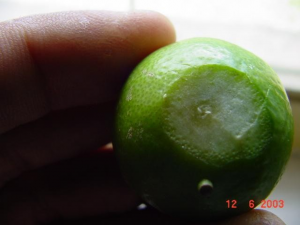
- From June onwards, you can see oviposition spots (punctures with a little rosin) in the upper half of fruit over 12 mm in size. Later, the fruit shows round, brownish, hard spots of 1-2 mm in diameter just under the skin. Spots usually stick to the segments, making the skin difficult to peel off. At harvest, some fruit still has a hard, dry segment containing a small maggot
- Fruits turn prematurely yellow and eventually drop prematurely. A sudden heavy fruit drop in October and November (late fruit drop) is visible.
- Dropped fruit contains maggots or shows maggot feeding signs like 1–5 damaged (dry) segments. Fruit without maggots shows an escape hole.
- From November to April, under heavily infested trees, you can find pupae in the soil
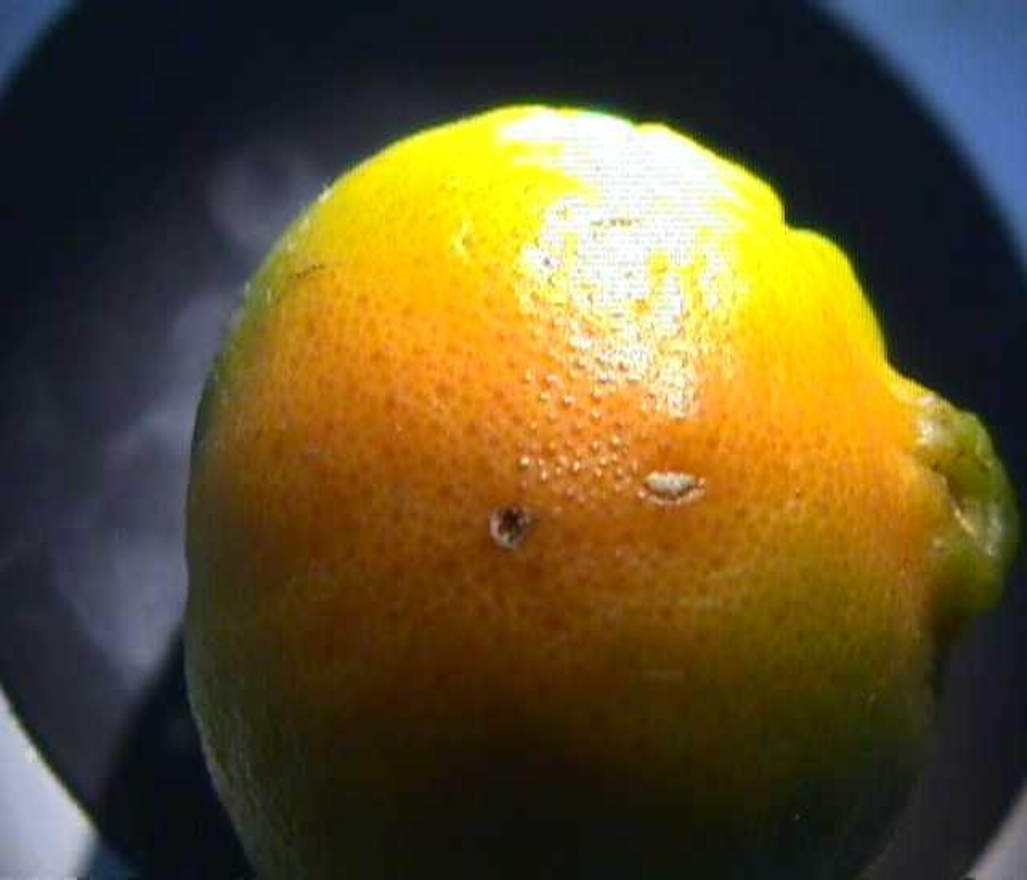
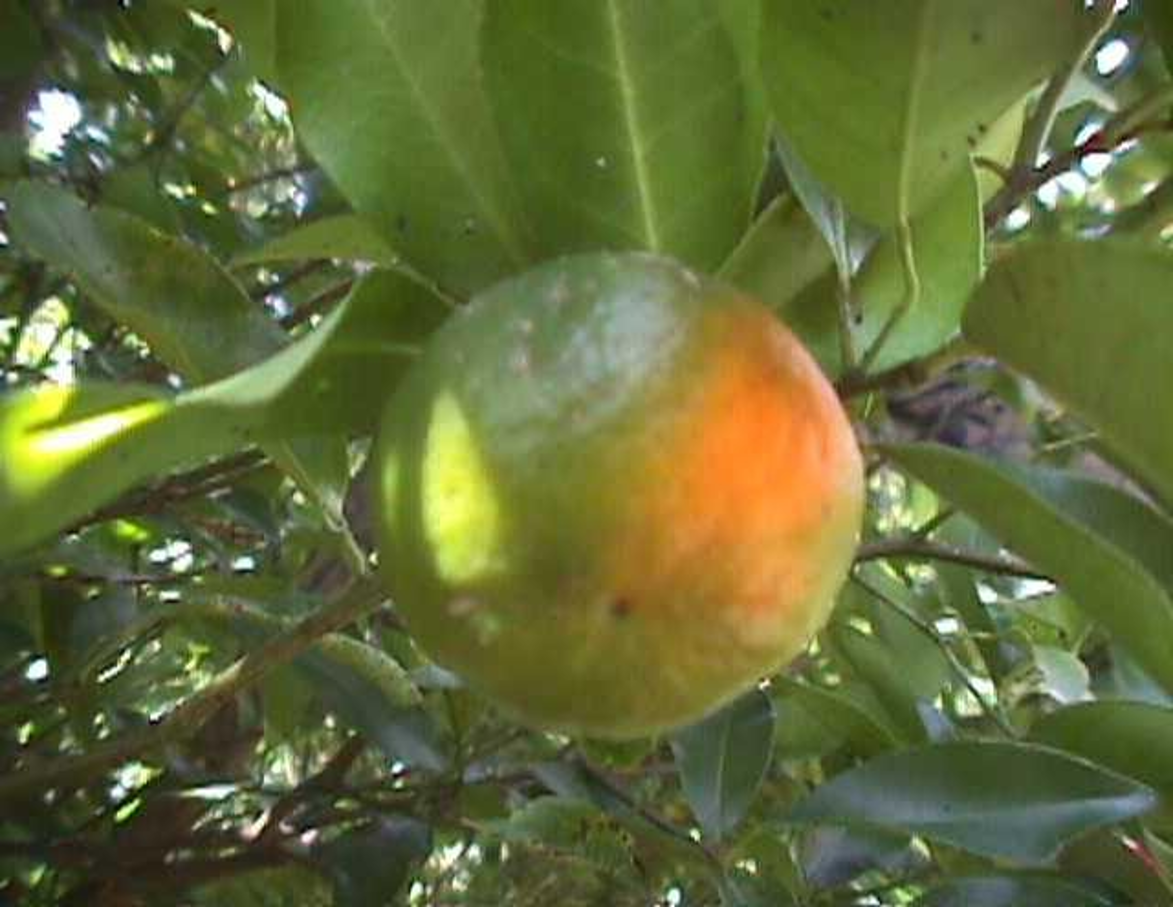
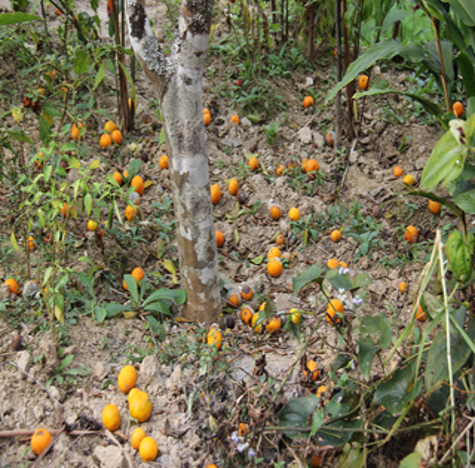
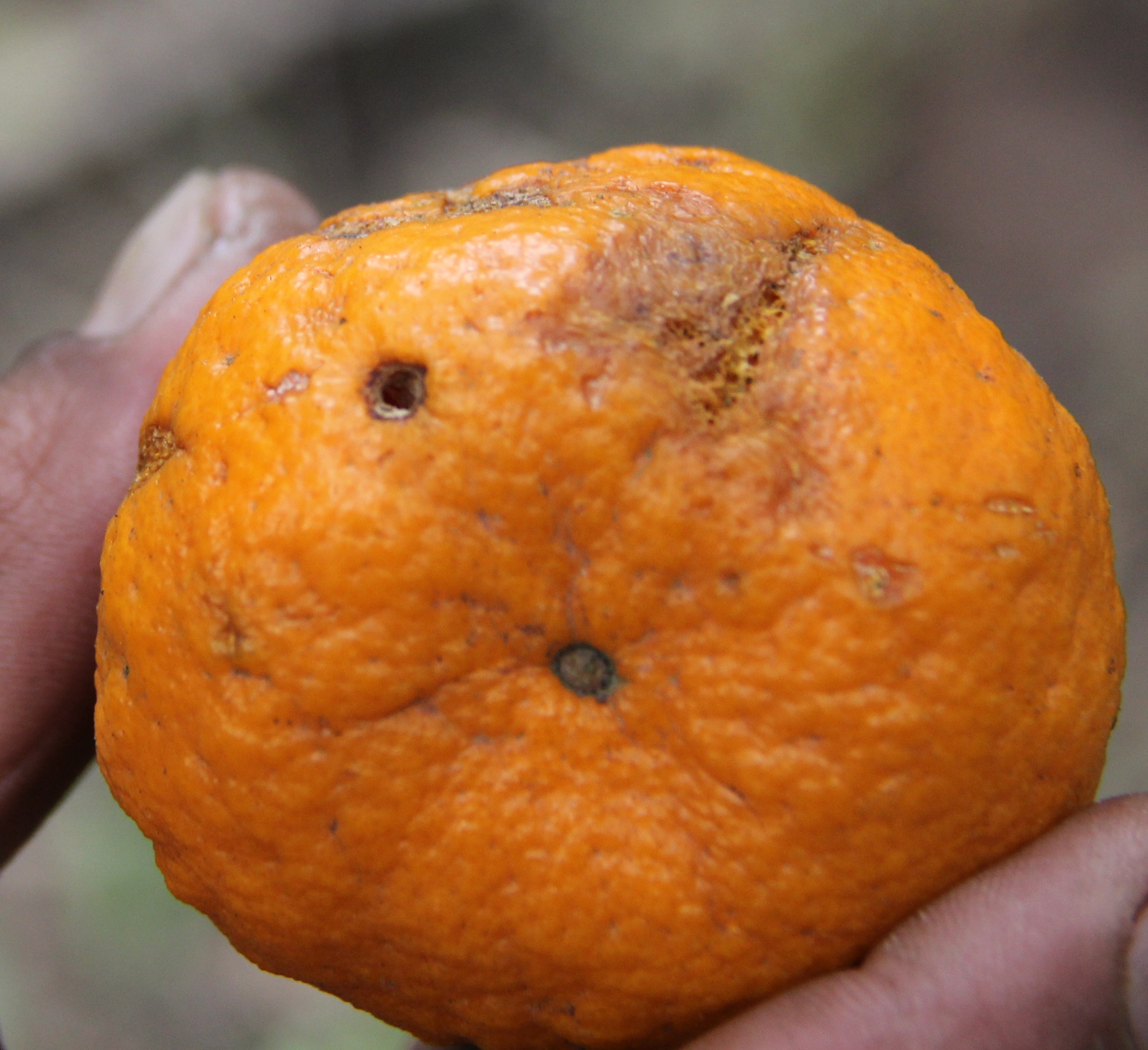
Confusion with other pests: It is the only fruit fly recorded from citrus. Fruit drop can be caused by various factors outlined below:
Fruit drop
Fruit drop occurs through various causes.
- Fruit drop just after fruit setting (fruit 1-2 mm in diameter) is natural; sometimes excessive drop may be caused by water or nutrient stress.
- Fruit drop at the marble stage (early fruit drop, fruit 10-15 mm) is probably caused by sucking insects like the Citrus shield bug.
- Sudden heavy fruit drop in October and November (late fruit drop) is caused by the Chinese citrus fly
Refer to this link: https://www.facebook.com/photo/?fbid=749051403922762&set=pb.100064537284984.-2207520000
Refer to this link to distinguish fruit drop by shield bug and citrus fruit fly: https://www.facebook.com/photo?fbid=749060237255212&set=pb.100064537284984.-2207520000
Video of fruit fly larvae in dropped citrus fruits https://www.facebook.com/100064537284984/videos/pcb.749051643922738/2135972853431957
BIOLOGY
Lifecycle: Female flies lay their eggs in mandarin fruits from June to August. Egg-laying commences when the first mandarin fruit reaches 11 mm in diameter, which is the first stage susceptible to fruit fly oviposition. Eggs are laid just under the skin of the fruits. The larvae (maggots) feed on the pulp and develop inside the maturing fruits. When the maggots are mature, they leave the fruit by making an exit hole and enter the soil to pupate. They pupate in the soil at a depth of a few centimeters. Puparia remain in the soil through the winter. In April, flies emerge from pupae.
Dispersal: Adults are good fliers and are likely to move easily between neighboring orchards.
When can damage be expected? The greatest losses are seen in orchards above 1200 m asl and in shady orchards at lower altitudes. Losses can be very high. 55% of the fruit drop was the result of a Chinese fruit fly in Lenkhar (Tashigang) in 1993, but this was expected to represent an upper limit in that area. Most orchards suffered from the attack.
Hosts: It utilizes a wide range of wild and edible citrus (Rutaceae), including sour orange, pomelo, wild lime, lemon, citron, mandarin, orange, tangerine, and cumquat.
MANAGEMENT PRACTICES
Successful management requires an integrated management approach throughout the year. As adults are good fliers, management needs to be coordinated across neighboring farms within a locality. The single most effective management action is to pick up and destroy all fallen fruit to prevent populations from surviving into the next season. Farmers obtain the best results if the collection of dropped fruits and bait spraying is carried out for two to three years in a row. Monitoring is critical for assessing the need for, and success of, the management program.
Monitoring
Dropped fruit should be assessed to estimate the percentage of losses resulting from fruit fly attacks. Collect 50 from across the orchard in September or October and split open to look for maggots. Estimates of fruit loss will allow you to monitor the success of your management program and modify it if necessary.
Effect of variety
Not known.
Non-chemical management
The collection and destruction of dropped fruits is the single most effective management action. However, everyone in the community needs to participate to prevent pockets of fruit fly from surviving.
- This method will reduce the fly population in the following year.
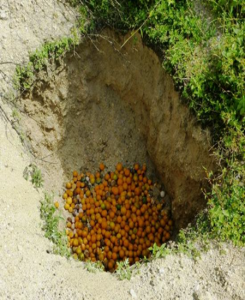
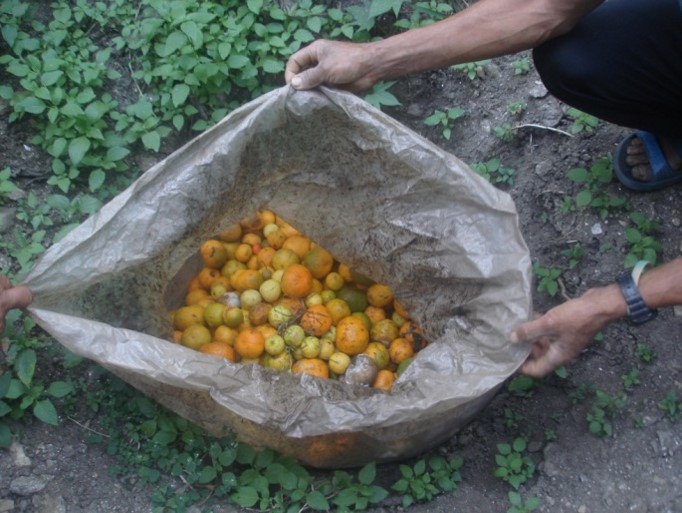
- From mid-October on, dropped fruits should be collected every 2–3 days. Doing it less often will allow maggots to leave the fruit and enter the soil.
- Fruit should be buried in pits 1-2 m deep, sprinkled with lime, and covered with soil once all the fruit has been collected. Ants and the rotting process will destroy the larvae and pupae. Alternatively, fallen fruits can be collected in a plastic bag and sealed completely for decomposition.
Protein bait spray
It is a cheap and simple IPM technique, but it works only when applied meticulously. The basic principle is that flies search for protein food, which they need to build their eggs. For selective control, we mix protein with an insecticide so that when the fly feeds, it will be poisoned and killed.
- To make bait sprays:
- Mix 50 g of protein hydrolysate, 20 ml of malathion, and 10 ml of Sandovit sticker in 10-liter water and allow the protein to dissolve. Note: Indent with your respective agriculture extension officer to get protein hydrolysate and insecticides
- To apply bait sprays:
- Splash 50 ml (half a tea glass full) of the solution into every second tree with a locally-made broom or something similar. Apply the mixture to every second tree, using two or three splashes on each.
- Splashing should be done on dry and sunny days so that the drops are at least dry. Rain after drying the drops is no problem, as the sticker keeps the protein/malathion stuck to the leaves.
- Repeat the splash from April 15th until August 15th every ten days (in heavily-infested villages) or every month (in low-infested villages).
Note:
- The best results are obtained if the method is carried out two to three years in a row, and in combination with dropped fruit destruction. If control is carried out properly, the fly population can practically be eradicated in three years with relatively little effort.
Chemical management
- Cover sprays are not recommended and are also not feasible where citrus trees are tall. There are no sprays available that can kill larvae, which are well-protected within the fruit.
Version: NPPC 2017. Chinese Fruit Fly V1.0. Bhutan Pest Factsheet. www.PestsofBhutan.nppc.gov.bt. Date produced: 14 April 2017. Last date modified: 28 Feb 2024. Contact: nppcsemtokha@gmail.com
Image acknowledgements: NPPC.
