


Cnaphalocrocis medinalis
Crop: Rice
Why is it a problem? The rice leaf folder attacks the tillering and booting stages. High densities can reduce seed production, but this is rare and management is normally not needed.
Where and when is it a problem? It is a commonly encountered pest, in part because of the obvious damage, but it rarely if ever reaches damaging densities. Most farmer complaints are received from eastern Bhutan.
IDENTIFICATION
Adult moths are medium-sized (8-10 mm long and 16-20 mm wing expanse). They are light brown with shiny, brownish-yellow wings adorned with dark, broad margins and 2-3 dark vertical stripes. Eggs are oval, creamy white. Newly emerged larvae are dull white or light yellow with a brown head, but soon turn green once feeding starts. Fully-grown larvae are slender and 20-25 mm long.
SYMPTOMS
It is a leaf-folding and leaf-feeding caterpillar that attacks tillering and booting stages. Caterpillars fold a rice leaf around them and attach the leaf margins with silk strands. They feed inside the folded leaf creating longitudinal white and transparent streaks on the blade. A heavily infested crop has streaks on the leaves and appears whitish from a distance. Feeding may also make plants prone to fungal and bacterial infection.

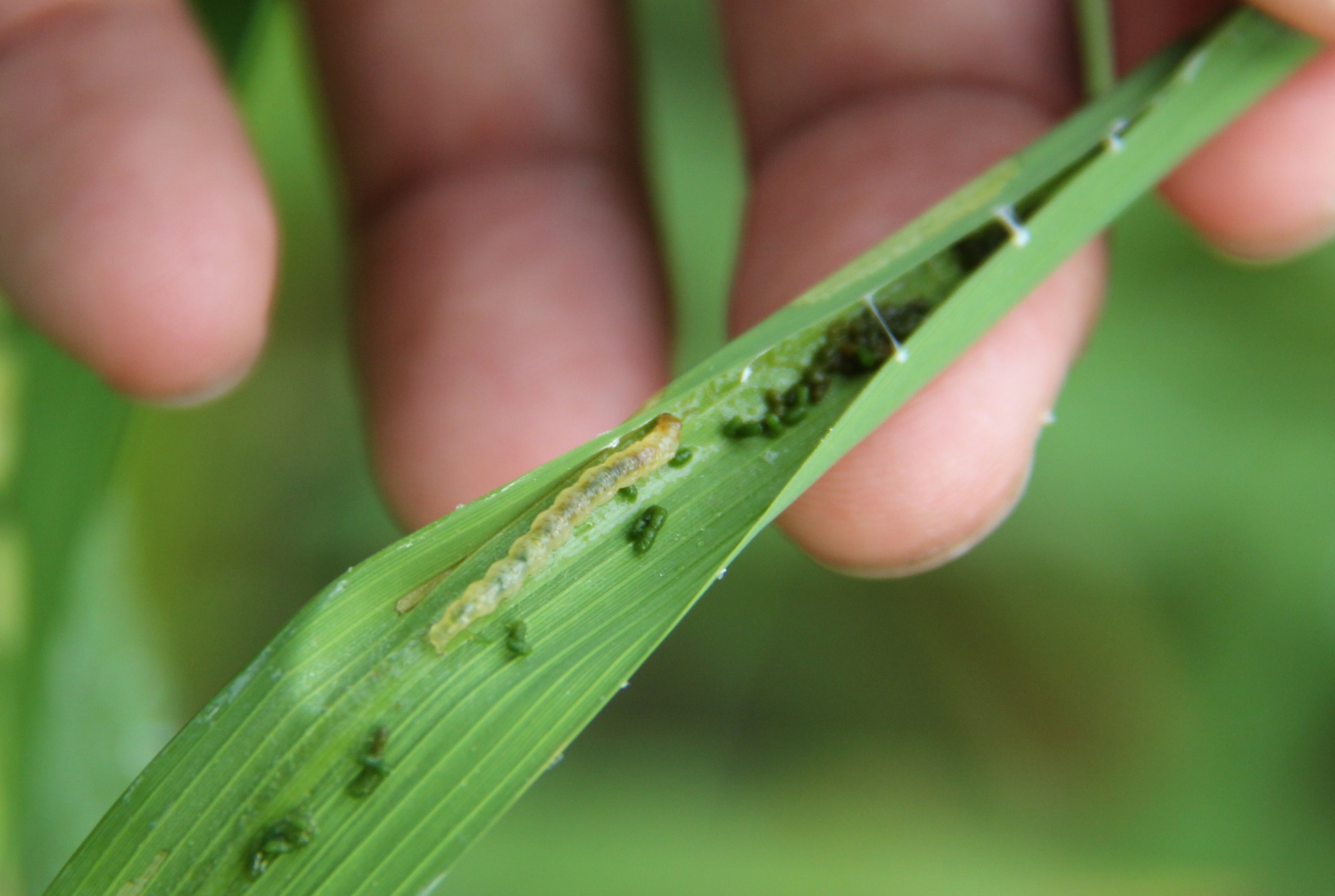

Confusion with other pests: There are several leaf-feeding pests of rice, but the rice leaf folder is the only one that commonly folds leaves. Look for the larvae to confirm identification.
BIOLOGY
Lifecycle: Eggs are laid singly or in pairs on the leaves and leaf sheaths. Young larvae feed on tender leaves without folding them. Older larvae construct leaf folds. Single larvae may damage multiple leaves. Larvae pupate in loose silken webs in between the leaves or in the leaf sheaths.
Dispersal: Adults fly.
When can damage be expected? It is a commonly encountered pest in rice fields, but outbreaks are rare.
Hosts: It has a wide host range but in Bhutan, it has only been recorded from rice.
MANAGEMENT PRACTICES
Although common and conspicuous, specific management is rarely needed. Management is only needed at high leaf-roller densities as modern varieties are generally capable of compensating for feeding damage that occurs during the vegetative stage. IRRI recommends that management may only be justified if the leaf-folder affects more than half of the flag (highest) leaf and the next two youngest leaves in each tiller.
Monitoring
Monitoring should be done at the same time as general scouting for rice pests and diseases. Estimate the average number of flags, and the next two youngest, leaves that are damaged.
Effect of variety
Studies by IRRI have found differences in resistance between cultivars.
Non-chemical management
- Use recommended fertilizer rates.
- Removing grassy weeds from rice fields and surrounding areas may prevent the build-up of rice leaf rollers on alternate hosts.
- A wide range of natural enemies normally keep this pest in check. Biological control agents are available elsewhere, including in Nepal.
Chemical management
The thresholds for managing infestations in paddy fields are typically based on the percentage of damaged leaves and the growth stage of the rice crop. Here are some commonly used thresholds:
- Nursery Stage:
- The presence of 1-2 larvae or 2-3 damaged leaves per square meter.
- Vegetative Stage (Tillering Stage):
- If more than 10% of the leaves show damage symptoms (folded leaves or window-pane feeding).
- Reproductive Stage (Panicle Initiation to Flowering Stage):
- If more than 5-10% of the leaves are damaged.
- Economic Threshold Level:
- In general, the economic threshold level is considered when 10-20% of leaves are damaged during the vegetative stage, or 5-10% during the reproductive stage
When chemical control is necessary, the following pesticides are commonly recommended:
- Chlorantraniliprole 12.5% SC: 0.3 ml per liter of water (60 ml per acre)
- Chlorpyrifos 20% EC: 4 ml per liter of water (200-400 ml per acre)
Version: NPPC 2017. Rice leaf folder V1.0. Bhutan Pest Factsheet. www.PestsofBhutan.nppc.gov.bt. Date produced: 14 April 2017. Contact: nppcsemtokha@gmail.com
Image acknowledgements: NPPC.
